 Add to Chrome
 Add to Firefox
 Add to Edge
SkillOpt: Executive Strategy for Self-Evolving Agent Skills
May 25, 2026
Agent skills today are hand-crafted, generated one-shot, or evolved through loosely controlled self-revision, none of which behaves like a deep-learning optimizer for the skill, and none of which reliably improves over its starting point under feedback. We argue the skill should instead be trained as the external state of a frozen agent, with the same discipline that makes weight-space optimization reproducible. SkillOpt is, to our knowledge, the first systematic controllable text-space optimizer for agent skills: a separate optimizer model turns scored rollouts into bounded add/delete/replace edits on a single skill document, and an edit is accepted only when it strictly improves a held-out validation score. A textual learning-rate budget, rejected-edit buffer, and epoch-wise slow/meta update make skill training stable while adding zero inference-time model calls at deployment. Across six benchmarks, seven target models, and three execution harnesses (direct chat, Codex, Claude Code), SkillOpt is best or tied on all 52 evaluated (model, benchmark, harness) cells and beats every per-cell competitor among human, one-shot LLM, Trace2Skill, TextGrad, GEPA, and EvoSkill skills. On GPT-5.5 it lifts the average no-skill accuracy by +23.5 points in direct chat, by +24.8 inside the Codex agentic loop, and by +19.1 inside Claude Code. Transfer experiments further show that optimized skill artifacts retain value when moved across model scales, between Codex and Claude Code execution environments, and to a nearby math benchmark without further optimization. Code: https://aka.ms/skillopt

From Raw Experience to Skill Consumption: A Systematic Study of Model-Generated Agent Skills
May 22, 2026Language agents increasingly improve by reusing \emph{skills} -- structured procedural artifacts distilled from past experience. In particular, \emph{domain-level} and \emph{model-generated} skills are especially promising. They offer fast adaptation within a domain by encoding domain-specific recurring procedures, and they scale beyond labor-intensive hand-crafting. However, while extraction methods continue to proliferate, understanding remains limited, with no comprehensive study spanning the full skill lifecycle -- \textbf{experience generation}, \textbf{skill extraction}, and \textbf{skill consumption} -- to ask whether such skills actually work, when they work, and what makes them succeed or fail. To close this gap, we build a utility-grounded evaluation framework that provides systematic experimental results across extractors and target agents, covering five diverse agentic task domains. We find that model-generated skills are beneficial on average but exhibit non-trivial negative transfer, and that neither extractors nor targets behave uniformly. A model can be a strong extractor yet a weak consumer, or vice versa, with skill utility independent of model scale or baseline task strength. To explain these patterns, we then dissect each lifecycle stage in depth, analyzing how experience composition shapes skill quality, what properties characterize useful skills, and how the same skill transfers across different consumers. Finally, we translate these findings into a concrete \emph{meta-skill} that guides skill extraction toward the features tied to actual utility, which consistently improves skill quality across domains and substantially reduces negative transfer.
SpaceDG: Benchmarking Spatial Intelligence under Visual Degradation
May 21, 2026Multimodal Large Language Models (MLLMs) have made rapid progress in spatial intelligence, yet existing spatial reasoning benchmarks largely assume pristine visual inputs and overlook the degradations that commonly occur in real-world deployment, such as motion blur, low light, adverse weather, lens distortion, and compression artifacts. This raises a fundamental question: how robust is the spatial intelligence of current MLLMs when visual observations are imperfect? To answer this question, we introduce SpaceDG, the first large-scale dataset for degradation-aware spatial understanding. It is constructed with a physically grounded degradation synthesis engine that embeds degradation formation process into 3D Gaussian Splatting (3DGS) rendering, enabling realistic simulation of nine degradation types. The resulting dataset contains approximately 1M QA pairs from nearly 1,000 indoor scenes. We further introduce SpaceDG-Bench, an human-verified benchmark with 1,102 questions spanning 11 reasoning categories and 9 visual degradation types, yielding over 10K VQA instances. Evaluating 25 open- and closed-source MLLMs reveals that visual degradations consistently and substantially impair spatial reasoning, exposing a critical robustness gap. Finally, we show that finetuning on SpaceDG markedly improves degradation robustness and can even surpass human performance under degraded conditions without any performance drop on clean images, highlighting the promise of degradation-aware training for robust spatial intelligence.
CrossEarth-SAR: A SAR-Centric and Billion-Scale Geospatial Foundation Model for Domain Generalizable Semantic Segmentation
Mar 12, 2026Synthetic Aperture Radar (SAR) enables global, all-weather earth observation. However, owing to diverse imaging mechanisms, domain shifts across sensors and regions severely hinder its semantic generalization. To address this, we present CrossEarth-SAR, the first billion-scale SAR vision foundation model built upon a novel physics-guided sparse mixture-of-experts (MoE) architecture incorporating physical descriptors, explicitly designed for cross-domain semantic segmentation. To facilitate large-scale pre-training, we develop CrossEarth-SAR-200K, a weakly and fully supervised dataset that unifies public and private SAR imagery. We also introduce a benchmark suite comprising 22 sub-benchmarks across 8 distinct domain gaps, establishing the first unified standard for domain generalization semantic segmentation on SAR imagery. Extensive experiments demonstrate that CrossEarth-SAR achieves state-of-the-art results on 20 benchmarks, surpassing previous methods by over 10\% mIoU on some benchmarks under multi-gap transfer. All code, benchmark and datasets will be publicly available.
ACE-Brain-0: Spatial Intelligence as a Shared Scaffold for Universal Embodiments
Mar 03, 2026Universal embodied intelligence demands robust generalization across heterogeneous embodiments, such as autonomous driving, robotics, and unmanned aerial vehicles (UAVs). However, existing embodied brain in training a unified model over diverse embodiments frequently triggers long-tail data, gradient interference, and catastrophic forgetting, making it notoriously difficult to balance universal generalization with domain-specific proficiency. In this report, we introduce ACE-Brain-0, a generalist foundation brain that unifies spatial reasoning, autonomous driving, and embodied manipulation within a single multimodal large language model~(MLLM). Our key insight is that spatial intelligence serves as a universal scaffold across diverse physical embodiments: although vehicles, robots, and UAVs differ drastically in morphology, they share a common need for modeling 3D mental space, making spatial cognition a natural, domain-agnostic foundation for cross-embodiment transfer. Building on this insight, we propose the Scaffold-Specialize-Reconcile~(SSR) paradigm, which first establishes a shared spatial foundation, then cultivates domain-specialized experts, and finally harmonizes them through data-free model merging. Furthermore, we adopt Group Relative Policy Optimization~(GRPO) to strengthen the model's comprehensive capability. Extensive experiments demonstrate that ACE-Brain-0 achieves competitive and even state-of-the-art performance across 24 spatial and embodiment-related benchmarks.
Out of the Memory Barrier: A Highly Memory Efficient Training System for LLMs with Million-Token Contexts
Feb 02, 2026Training Large Language Models (LLMs) on long contexts is severely constrained by prohibitive GPU memory overhead, not training time. The primary culprits are the activations, whose memory footprints scale linearly with sequence length. We introduce OOMB, a highly memory-efficient training system that directly confronts this barrier. Our approach employs a chunk-recurrent training framework with on-the-fly activation recomputation, which maintains a constant activation memory footprint (O(1)) and shifts the primary bottleneck to the growing KV cache. To manage the KV cache, OOMB integrates a suite of synergistic optimizations: a paged memory manager for both the KV cache and its gradients to eliminate fragmentation, asynchronous CPU offloading to hide data transfer latency, and page-level sparse attention to reduce both computational complexity and communication overhead. The synergy of these techniques yields exceptional efficiency. Our empirical results show that for every additional 10K tokens of context, the end-to-end training memory overhead increases by a mere 10MB for Qwen2.5-7B. This allows training Qwen2.5-7B with a 4M-token context on a single H200 GPU, a feat that would otherwise require a large cluster using context parallelism. This work represents a substantial advance in resource efficiency for long-context LLM training. The source code is available at https://github.com/wenhaoli-xmu/OOMB.
MM-CRITIC: A Holistic Evaluation of Large Multimodal Models as Multimodal Critique
Nov 12, 2025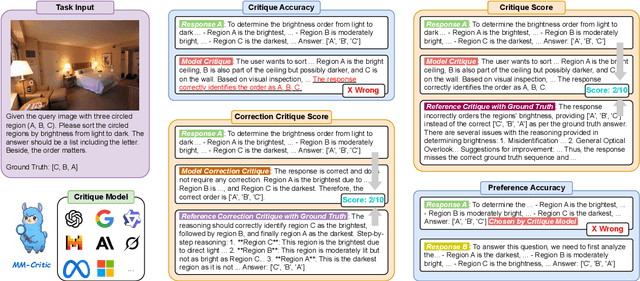

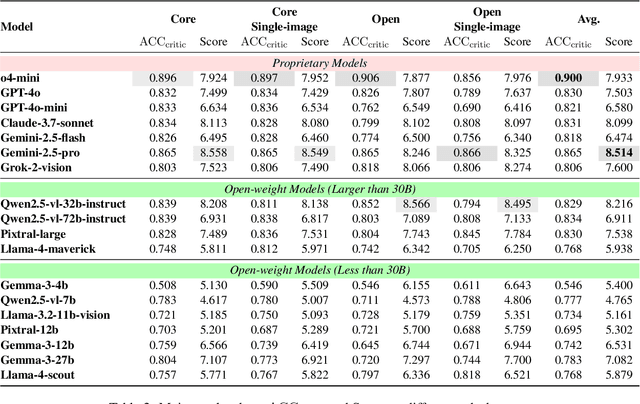
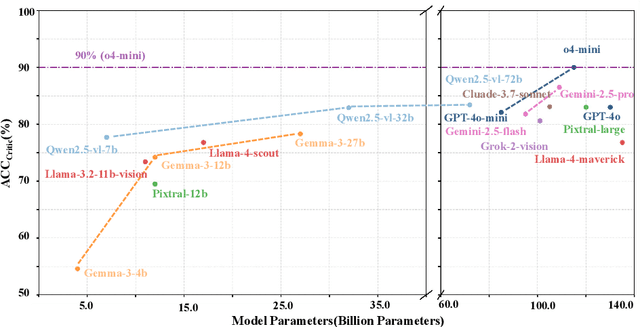
The ability of critique is vital for models to self-improve and serve as reliable AI assistants. While extensively studied in language-only settings, multimodal critique of Large Multimodal Models (LMMs) remains underexplored despite their growing capabilities in tasks like captioning and visual reasoning. In this work, we introduce MM-CRITIC, a holistic benchmark for evaluating the critique ability of LMMs across multiple dimensions: basic, correction, and comparison. Covering 8 main task types and over 500 tasks, MM-CRITIC collects responses from various LMMs with different model sizes and is composed of 4471 samples. To enhance the evaluation reliability, we integrate expert-informed ground answers into scoring rubrics that guide GPT-4o in annotating responses and generating reference critiques, which serve as anchors for trustworthy judgments. Extensive experiments validate the effectiveness of MM-CRITIC and provide a comprehensive assessment of leading LMMs' critique capabilities under multiple dimensions. Further analysis reveals some key insights, including the correlation between response quality and critique, and varying critique difficulty across evaluation dimensions. Our code is available at https://github.com/MichealZeng0420/MM-Critic.
ProCLIP: Progressive Vision-Language Alignment via LLM-based Embedder
Oct 22, 2025The original CLIP text encoder is limited by a maximum input length of 77 tokens, which hampers its ability to effectively process long texts and perform fine-grained semantic understanding. In addition, the CLIP text encoder lacks support for multilingual inputs. All these limitations significantly restrict its applicability across a broader range of tasks. Recent studies have attempted to replace the CLIP text encoder with an LLM-based embedder to enhance its ability in processing long texts, multilingual understanding, and fine-grained semantic comprehension. However, because the representation spaces of LLMs and the vision-language space of CLIP are pretrained independently without alignment priors, direct alignment using contrastive learning can disrupt the intrinsic vision-language alignment in the CLIP image encoder, leading to an underutilization of the knowledge acquired during pre-training. To address this challenge, we propose ProCLIP, a curriculum learning-based progressive vision-language alignment framework to effectively align the CLIP image encoder with an LLM-based embedder. Specifically, ProCLIP first distills knowledge from CLIP's text encoder into the LLM-based embedder to leverage CLIP's rich pretrained knowledge while establishing initial alignment between the LLM embedder and CLIP image encoder. Subsequently, ProCLIP further aligns the CLIP image encoder with the LLM-based embedder through image-text contrastive tuning, employing self-distillation regularization to avoid overfitting. To achieve a more effective alignment, instance semantic alignment loss and embedding structure alignment loss are employed during representation inheritance and contrastive tuning. The Code is available at https://github.com/VisionXLab/ProCLIP.
Spotlight Attention: Towards Efficient LLM Generation via Non-linear Hashing-based KV Cache Retrieval
Aug 27, 2025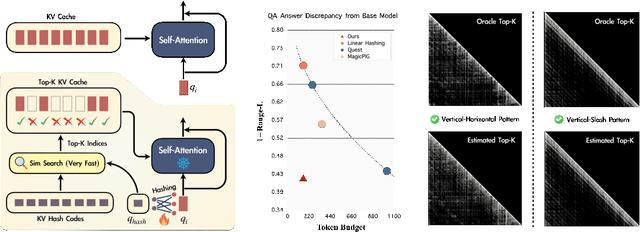

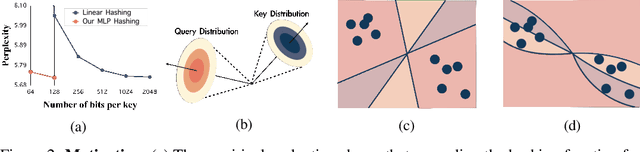
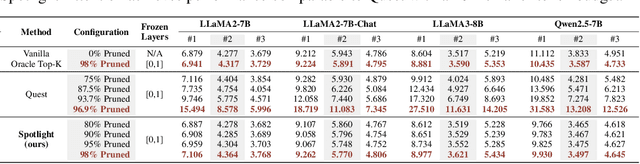
Reducing the key-value (KV) cache burden in Large Language Models (LLMs) significantly accelerates inference. Dynamically selecting critical KV caches during decoding helps maintain performance. Existing methods use random linear hashing to identify important tokens, but this approach is inefficient due to the orthogonal distribution of queries and keys within two narrow cones in LLMs. We introduce Spotlight Attention, a novel method that employs non-linear hashing functions to optimize the embedding distribution of queries and keys, enhancing coding efficiency and robustness. We also developed a lightweight, stable training framework using a Bradley-Terry ranking-based loss, enabling optimization of the non-linear hashing module on GPUs with 16GB memory in 8 hours. Experimental results show that Spotlight Attention drastically improves retrieval precision while shortening the length of the hash code at least 5$\times$ compared to traditional linear hashing. Finally, we exploit the computational advantages of bitwise operations by implementing specialized CUDA kernels, achieving hashing retrieval for 512K tokens in under 100$\mu$s on a single A100 GPU, with end-to-end throughput up to 3$\times$ higher than vanilla decoding.
Partial Weakly-Supervised Oriented Object Detection
Jul 03, 2025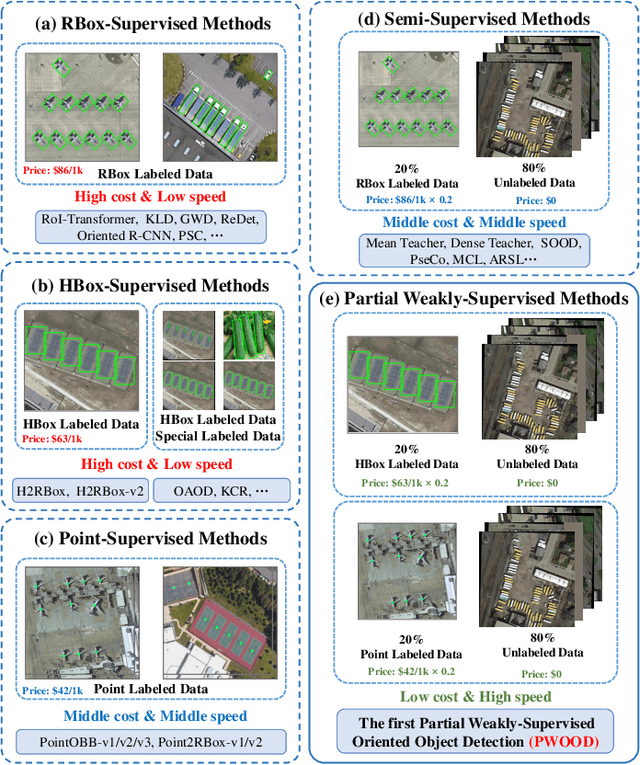
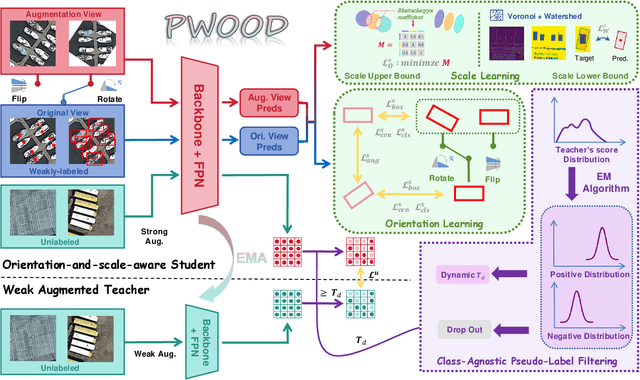
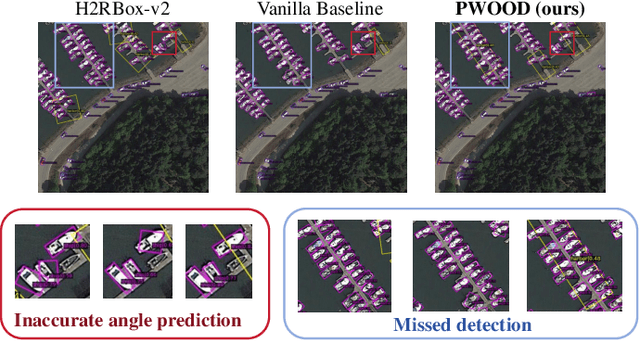
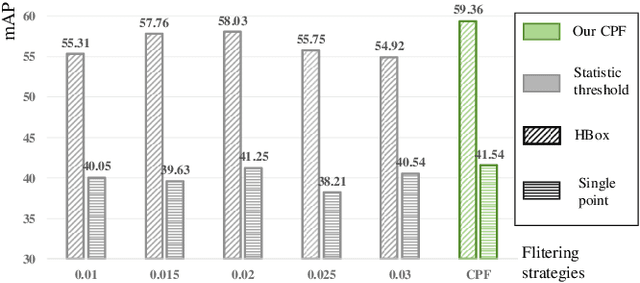
The growing demand for oriented object detection (OOD) across various domains has driven significant research in this area. However, the high cost of dataset annotation remains a major concern. Current mainstream OOD algorithms can be mainly categorized into three types: (1) fully supervised methods using complete oriented bounding box (OBB) annotations, (2) semi-supervised methods using partial OBB annotations, and (3) weakly supervised methods using weak annotations such as horizontal boxes or points. However, these algorithms inevitably increase the cost of models in terms of annotation speed or annotation cost. To address this issue, we propose:(1) the first Partial Weakly-Supervised Oriented Object Detection (PWOOD) framework based on partially weak annotations (horizontal boxes or single points), which can efficiently leverage large amounts of unlabeled data, significantly outperforming weakly supervised algorithms trained with partially weak annotations, also offers a lower cost solution; (2) Orientation-and-Scale-aware Student (OS-Student) model capable of learning orientation and scale information with only a small amount of orientation-agnostic or scale-agnostic weak annotations; and (3) Class-Agnostic Pseudo-Label Filtering strategy (CPF) to reduce the model's sensitivity to static filtering thresholds. Comprehensive experiments on DOTA-v1.0/v1.5/v2.0 and DIOR datasets demonstrate that our PWOOD framework performs comparably to, or even surpasses, traditional semi-supervised algorithms.